Over the years, the PDA has gathered a wealth of information and knowledge linked to medicine-related queries received and the support provided in response to them.
Whilst members will be familiar with the use of steroid cards and the need for patients on long-term treatment not to stop it suddenly, the unwanted effects related to unintentional or poorly monitored extended use of all forms of steroids can result in significant patient harm and should be at the forefront of considerations when dealing with prescriptions. If left unaddressed, extended use can result in significant and, in some cases, irreversible harm.
The PDA reminds members of the importance of engaging professional curiosity whenever they see prescriptions for oral, inhaled, nasal, topical or ocular steroids which seem unusual, or which appear to have continued for longer than generally expected. Pharmacists practicing in primary care and community pharmacy can help to ensure that prescribing is appropriate. Pharmacists working in secondary care can identify anomalies when reconciling patient medicines on admission.
Members should be aware that in some cases, prolonged use of steroids may be due to an error, with the continuation of medicines which were only intended for short-term use on a patient’s repeat prescription. This can be compounded by poor general practice repeat prescription monitoring processes which may fail to identify these errors in a timely manner. A failure to provide patients with sufficient information to enable them to utilise their medicines safely can also be an issue.
Even when prolonged use is clinically appropriate due to the patient’s underlying condition, members should ensure that all possible mitigating measures are in place to reduce the impact of adverse effects. Below are reminders of the harm which may accompany prolonged use of corticosteroid preparations.
Adverse effects of steroid therapy
Prolonged high-dose use of steroids can result in adverse effects (this list is not exhaustive):
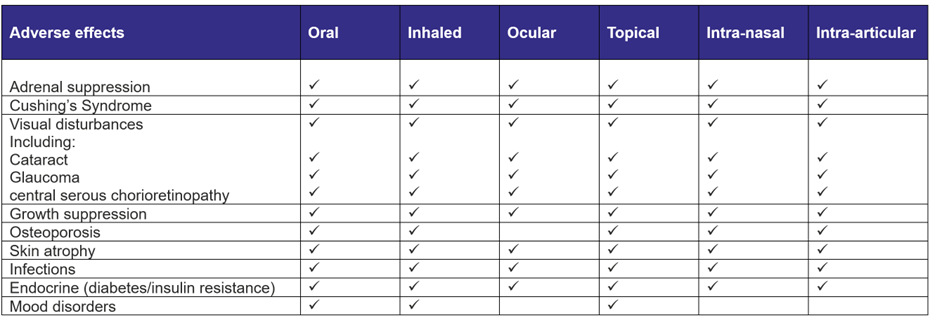
If in any doubt, members should consult the relevant Summary of Product Characteristics (SmPC) via the Electronic Medicines Compendium website.
Further information on adverse effects is available via BNF Treatment summaries: BNF: corticosteroids general use
The Medical Defence Union noted in 2016 that steroids are in the top 10 of most common drugs involved in clinical negligence prescription error claims.
Mitigating actions
PDA members can help to mitigate potential harm from steroid use by ensuring that they remain vigilant for unusual or concerning prescriptions and signs of adverse reactions in their patients.
The general recommended approach is that steroids should be used at the lowest dose and for the shortest time to control symptoms. Where long-term treatment is required, regular review and step-down of doses or intermittent treatment is also suggested. Consider the following:
- Are there patients who appear to receive continuous or very frequently repeated higher dose oral, inhaled or topical therapy?
- Are patients with psoriasis using high-potency steroids for longer than four weeks at a time?
- Are patients prescribed corticosteroid eye drops (usually reserved for short-term use) on repeat prescription?
Members should also ensure that patients have received relevant support material and have been made aware of the risks associated with long-term steroid use, potential red flags for adverse reactions and are aware of steps to take should they have concerns.
If appropriate, blue treatment or red emergency steroid cards should be issued to the patient by the prescriber but may also be issued at the point of dispensing if required; if dosages are changed, members should ensure the details on the steroid card are up to date.
Extensive advice on systemic and topical treatment and adverse effects can be found in the BNF Clinical Knowledge and Skills online sections:
- NICE-BNF – Corticosteroids – oral management – this provides information on Steroid Alert and Emergency cards and sick day rules advice
- NICE – BNF – Corticosteroids – inhaled treatment
- NICE-BNF- Corticosteroids – topical treatment
Conclusion
Whilst forming an essential part of treatment for a wide range of conditions, the potential adverse effects of prolonged use of corticosteroid medicines make it incumbent upon any clinicians involved in the prescribing, dispensing or review of steroid medicines in all sectors to ensure that the prescriptions which patients receive are intended for long-term use, are safe and appropriate and that patients have been fully informed of benefits and risks.
Learn more
- Exogenous steroids, adrenal insufficiency and adrenal crisis-who is at risk and how should they be managed safely. Society for Endocrinology Steroid Emergency Card Working Group and Specialist Pharmacy Services. March 2021.
- Online BNF – Adrenal Insufficiency
- Royal College of General Practitioners – Steroids and the Eye
- StatPearl- Steroid-induced glaucoma, 16 July 2023
- Drug Safety Update – Corticosteroids: rare risk of Central serous chorioretinopathy with local as well as systemic administration, 15 August 2017
- BLODGETT FM, FURGIN L, lazzoNi D: Effects of prolonged cortisone therapy on the statural growth, skeletal maturation and metabolic status of children. NEng J Med 254:636, 1956
- Royal Osteoporosis Society, Steroids(glucocorticoids) and bone health
- MHRA December 2014
- MDU Journal, Prescription errors 27 July 2016
Not yet a PDA member?
If you have not yet joined the PDA, we encourage you to join today and ask your colleagues to do the same.
Membership is FREE to pharmacy students, trainee pharmacists and for the first three months of being newly qualified.
Read about our key member benefits here.